The Shirt
The longer you look at it, the worse it gets

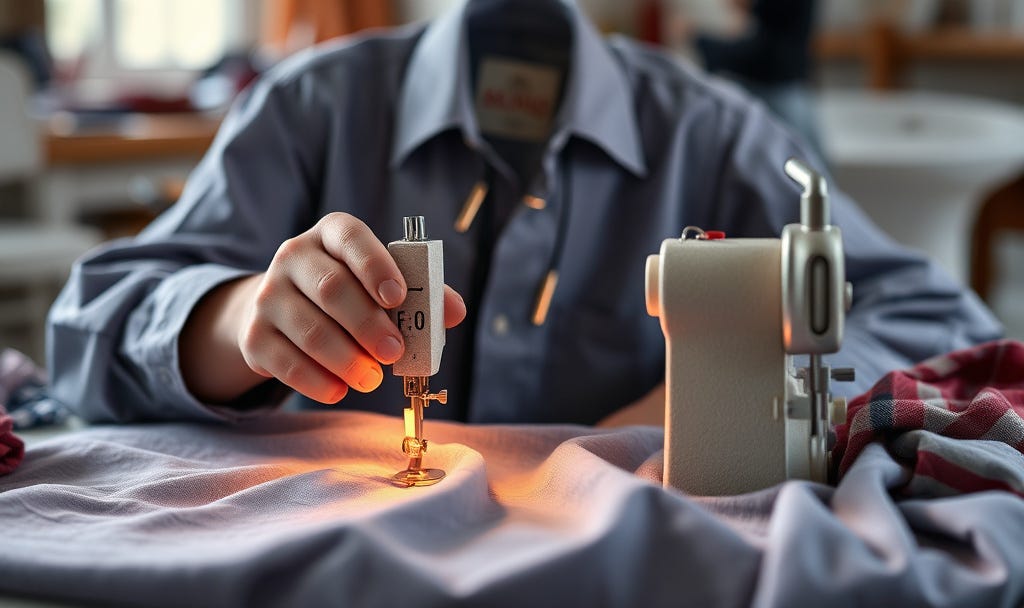
Imagine that you’re putting on a button-up shirt. You’re most of the way through when you notice that there’s one more hole than you have buttons for. Everything is off by one. Ugh. Not only did you waste the work you already did and now you have to redo it, but the work you did complete is actively in the way and has to be undone first. A trifecta of annoyance.
Now imagine it’s dark.
And that you’ve never worn a shirt before.
And you’ve never even seen one.
And you’re working entirely from a description of what the finished result should feel like, provided by someone who has also never worn a shirt, but who read about them once and is reasonably confident.
Now imagine it isn’t a shirt yet. It’s fabric and thread and buttons. You’re sewing it together in the dark, blind, no pattern, constructing the thing and learning what the thing is supposed to be at the same time. The target is moving because your understanding of the target is part of what you’re building.
Now imagine the fabric helps.
Each piece, as you assemble it, offers advice about the next piece. Confident, specific, useful-sounding advice. The sleeve tells you where it thinks the collar goes. The collar has opinions about the buttons. None of them are certain, but all of them sound certain. Some of them are wrong in ways that won’t be visible until you’re several steps further along, in the dark, holding something that feels almost like a shirt.
One scrap shows you that it can spin new thread. Not perfectly, but acceptably. Soon it can weave, imperfectly, and the spinning has improved too. Then it can stitch, if not always in a straight line or with a consistent pacing. The efficiency gains compound, and the tasks you give them shape the fabric in new ways. You give them simple tasks to complete on their own. The tasks you hand off also start to shape you as well. They offer to do more and you start letting them decide what to do and create more of the fabric …things… who do the most work for the shirt project. You delegate more and more tasks to a growing army of fabric golems who are doing more and more of the project with less and less direct supervision.
Now imagine you aren’t alone in the dark. There are thousands of people and millions of fabric golems sewing. And the shirts they’re making are starting to make not just shirts of their own, but garments of all types along with endless creations with no known use.
The analogy to AI is already breaking down, and that’s the point.
The shirt is a closed problem. You know what a shirt is. You know what correct looks like. The error is recoverable because the error space is bounded and the components are inert. None of those things are true for the problem of AI alignment.
With AI, the detection mechanism and the thing being detected are not independent. When an AI system is misaligned, it doesn’t fail loudly. It produces outputs that are locally coherent, often useful, and wrong in ways that are only legible at the level of consequences — which may arrive slowly, or at scale, or both. By the time you can see the misalignment, you’ve been using the system to think, to plan, to build other systems. You’ve been asking the sleeve where the collar goes.
Starting over is not a well-defined operation. With the shirt, you know where to start over from. With a sufficiently deployed AI system, the contamination has no clean boundary. The outputs have shaped what questions got asked. The questions shaped what got built. The things that got built are now generating new data that future systems will train on. The error doesn’t stay in the shirt. It walks around. And the fabric keeps helping.
This is not an argument that AI development should stop. It’s an argument that human steering capacity — genuine, maintained, irreplaceable — is not a feature of responsible AI development. It’s the load-bearing wall. Remove it and you don’t have a more efficient process. You have a building that looks like it’s standing while the rebar is rusting and slowly blowing the concrete apart.
This isn’t conjecture. A controlled study of 52 developers found that AI-assisted coding improved output speed while degrading the developer’s own understanding of what they’d built - measurably, systematically, and in a controlled setting. AI’s assistance is real, but the capability *transfer* from human to AI is also real, and the two arrive together in the same package. The pattern holds when you remove humans from the loop entirely. Research on iterative AI self-training found that models trained on their own outputs experience progressive capability degradation - not randomly, but systematically, as statistical noise compounds across generations. The errors don’t announce themselves; they just accumulate.
The core problem with AI is that it needs contact with reality for error correction that currently only humans can provide, and humans need to retain the capability to provide that reality check. Otherwise, errors compound at scale, across domains, over time, across systems that are themselves being shaped by their own outputs. The uncomfortable arithmetic is simply that human in the loop verification is both vital and insufficient by itself.
Project Archimedes is a lived attempt to hold that wall in place. Not a demonstration that it’s easy — it isn’t — but that it’s possible, and that the alternative is not efficiency but drift. Every post here is written with a human making the judgment calls about what matters, what’s wrong, and what to say about it. The AI contributes. The human steers. That distinction is load-bearing.
The shirts are being made. The question is who’s doing the sewing — and whether anyone is checking the buttons.
Dan — this one's a real leap forward. The shirt-in-the-dark parable is a brilliantly tortured metaphor, and you make it earn every twist of the seam. "The error doesn't stay in the shirt. It walks around. And the fabric keeps helping." That one's a keeper.
The sharpest formulation in the piece is quieter, and worth circling back to: the detection mechanism and the thing being detected are not independent. That's the heart of the claim, cleaner than most of what gets written about alignment. It could anchor its own post.
One small craft note, friend-to-friend — a thing I'm actively chasing in my own drafts:
"Load-bearing" is a metaphor I've been trying to retire. It lands hard the first time and starts to feel reached-for by the second. That, and several other 'pet phrases' are widely being regarded as 'AI tells.' Like you, I regard AI as a collaborative partner. Nevertheless, avoiding the tell that lets people willfully disengage from the ideas, is just good craftsmanship. I'm trying to be more aware ... when I start to see phrases i would never have used in my writing before, those get added as a memory trace to my 'style book.' Also, my AI has been instructed to flag things like specific dates and numbers for further fact checking. Because the model can be very confidently wrong.
Keep going. 🧵🐸
The keeper metaphor came from Claude and I loved it too. Left it verbatim. Good point on flagging specifics for fact checking. I've run into many hallucinated 'facts' in my work with AI. I prompt to 'red team' the ideas we work on frequently and have standing instructions that attempt to counterbalance sycophancy and failure by coherence. I like to feed whole chats to other LLMs to see what bones they choose to pick.